The island of Phuket in Thailand has a very international restaurant scene. I didn’t do an exact analysis, but I suspect purely Thai restaurants are a minority. Phuket is very touristy, and restaurant menus are not only in Thai and English but also in Chinese and Russian. There is a lot of Italian food, American food, and even Russian food on menus. Some restaurants don’t even include the Thai names of Thai dishes. And if the restaurants are Thai, the Thai food is mostly from all over the country.
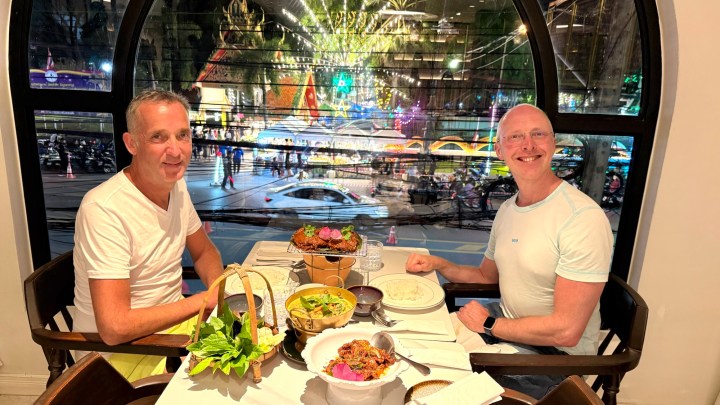
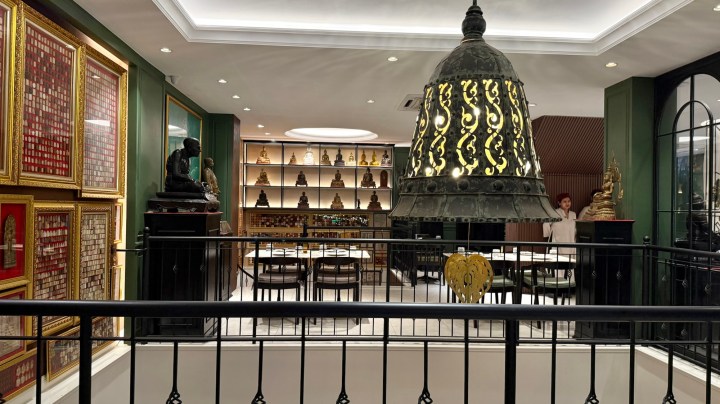
But if you look hard enough, there are some restaurants that do specialize in Southern Thai cuisine—like Bucha Gallery and Restaurant, which actually specializes in Pak Phanang cuisine. This is a city about 200 km (150 miles) east of Phuket, on the east coast of the Thai mainland. Compared to most of the other restaurants here, I’d still call the food they serve “local.”
The southern part of Thailand was a trading hub in the 18th century, so the cuisine was heavily influenced by Malaysia, India, and China. Just like elsewhere in Thailand, it’s all about the balance between spicy, salty, sweet, and sour, but the food here is spicier than in Northern Thailand. However, as in all Thai restaurants I’ve been to, they seem hesitant to serve spicy food to foreigners. Spicy like the Thai eat themselves is too hot for me, but the “medium spicy” they served at Bucha at our request was less spicy than the Thai food I cook at home. With some dishes, they served thinly sliced raw red chilies on the side so we could regulate our own level of heat.
We discovered this restaurant for our penultimate dinner on Phuket and liked it so much that we returned the next day to try more dishes. I’m covering both meals in this review, starting with the appetizers from both meals and finishing with the mains. The portions are quite generous, and we wanted to try a lot of dishes, so we didn’t have room for dessert. There was a limited wine list with high but not crazy prices, but we decided to just drink water. There is no tasting menu or wine pairing. The prices are higher than at average Thai restaurants (which are dirt cheap, most dishes costing around €3); around THB 500 (€14) per dish.
Appetizers
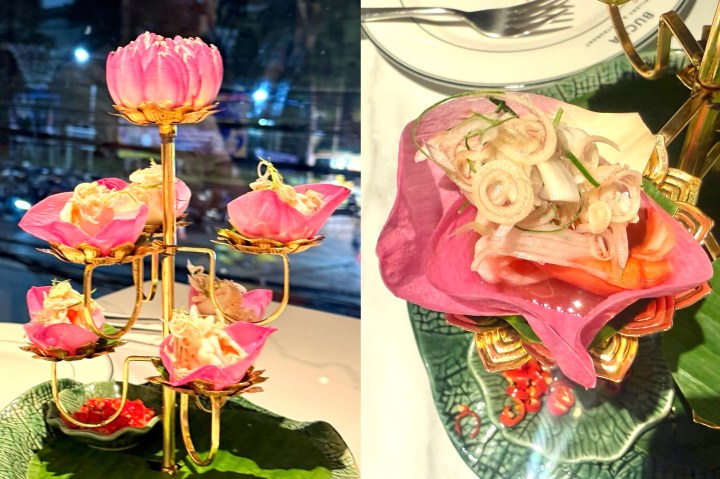
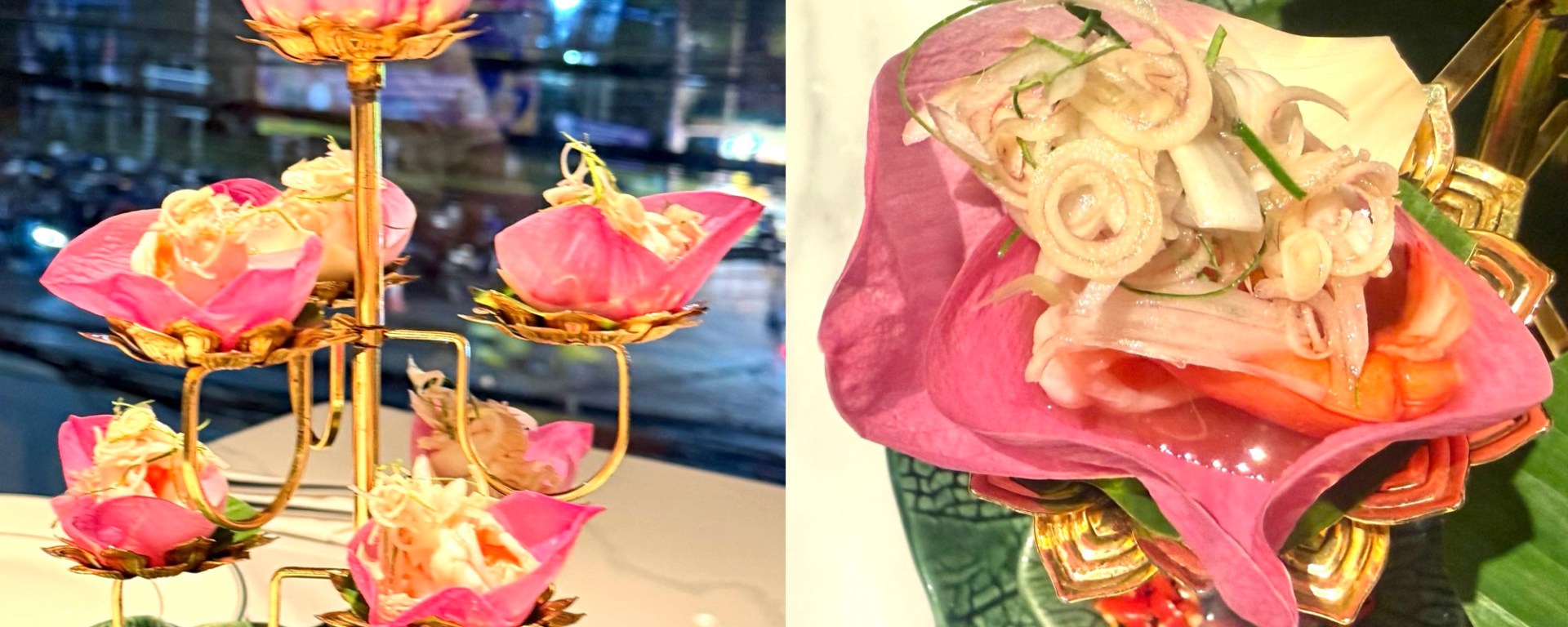
The signature dish of the restaurant is a Lotus Flower Salad. The Thai word for lotus flower is bucha, like the name of the restaurant. The name of the dish is yam bucha; yam is Thai for salad. It uses different parts of the lotus plant as its main ingredients: petals, stems, and roots (I didn’t notice lotus seeds, but they could be included too). The dressing is the usual Thai combination of lime juice, fish sauce, and palm sugar, with the chilies served on the side. There were also shallots, lemongrass, and kaffir lime leaf. Each petal of the lotus flower contained a steamed shrimp. A bright, complex, and balanced flavor, with the crunchy textures from the lotus parts providing a nice contrast to the plump shrimp.
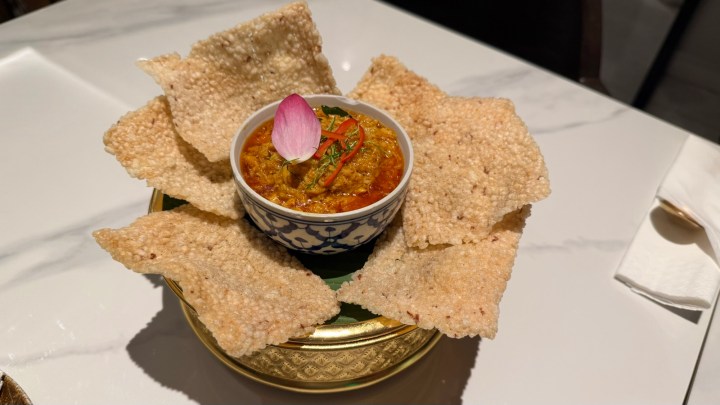
Khao Tang Kaeng Poo is a traditional Thai appetizer that combines rice crackers (khao tang) with a crab curry dip (kaeng poo). The crispy rice cakes are made from leftover rice that’s dried and deep-fried until golden and crunchy. The savory crab curry dip is served warm and made with coconut milk and red curry paste. It is seasoned with palm sugar and fish sauce. This was probably our favorite of all of the dishes we tried at Bucha with a deep yet balanced flavor and a very nice contrast between the crispy crackers and the rich crab curry.
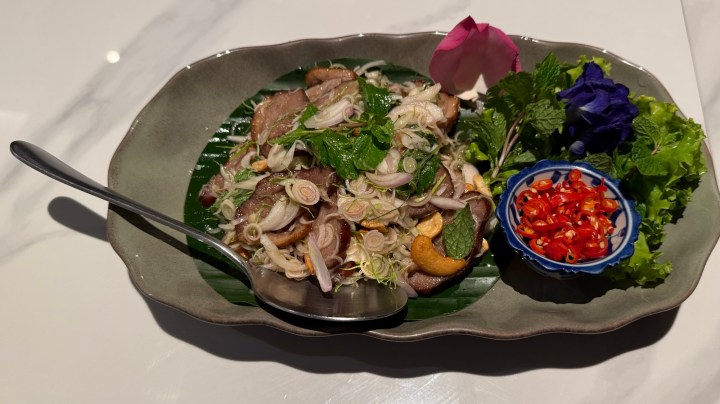
Yam Takrai Ped is a duck and lemongrass salad. The duck breast was thinly sliced and served warm. Apart from thinly sliced lemongrass, the salad also contained shallots, mint leaves, toasted cashews, and a dressing of lime juice, fish sauce, and palm sugar, with the chilies served on the side.
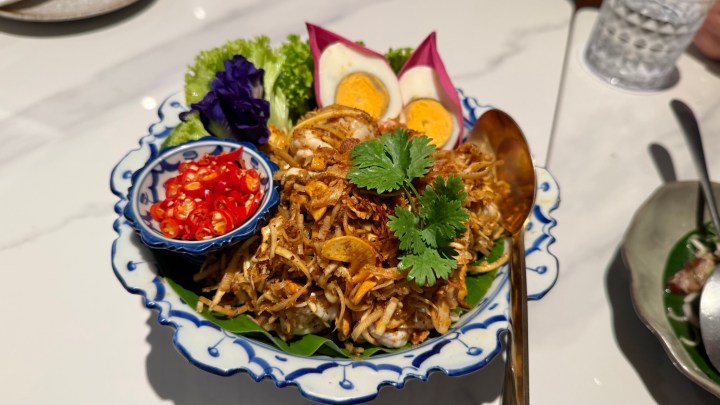
We were curious to try the Banana Blossom Salad here because we had enjoyed it at Locus paired with shredded duck confit. At Bucha, it came with hard-boiled egg and steamed shrimp. The main ingredient of yam plik kluay is the banana blossom (also called banana heart), the large purple-red bud at the end of a banana cluster. It has a slightly bitter, nutty flavor and a crunchy texture. The salad also included toasted cashews, lemongrass, shallots, and the same lime–fish sauce–palm sugar dressing as the other salads. The banana blossom is mostly about texture and doesn’t offer much in terms of flavor.
Mains
As usual, several mains were served at the same time with rice. The Thai way of eating is to take a bit of rice and a bit of one dish in each bite, rather than finishing the mains one by one.
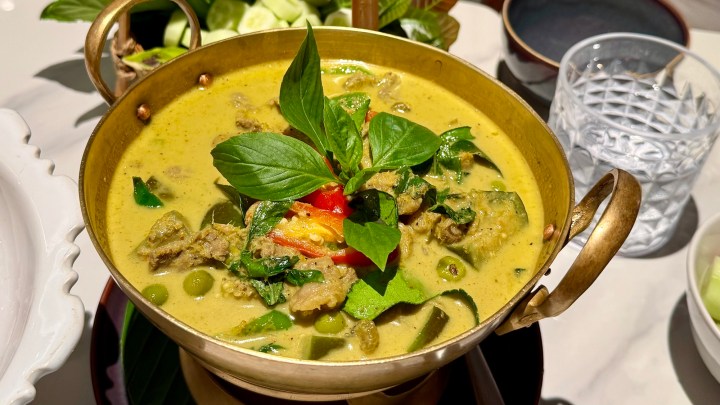
Gaeng Khiao Wan Nuea Tid Man is a green curry with fatty beef. The curry, requested “medium” spicy, was well balanced and aromatic. The beef, however, was not very tender; it seemed to have been cooked only briefly in the curry and did have bits of fat. The dish featured both small and tiny eggplants—I’m not fond of the tiny ones as they tend to be quite bitter—but I did enjoy the sweet basil leaves.
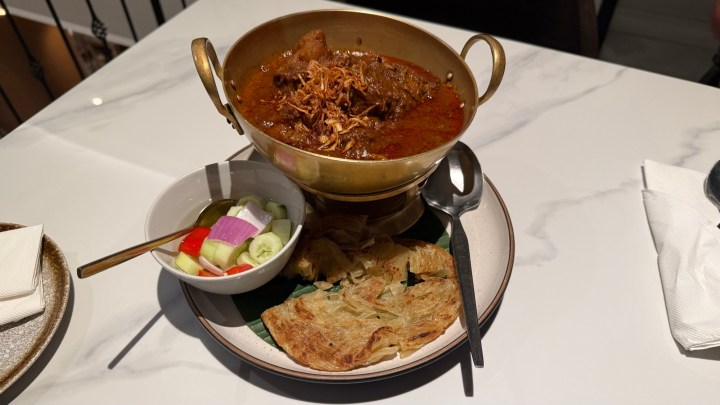
The next day we ordered the beef Massaman curry, expecting the beef to be more tender. It had indeed been simmered until you could pull it apart with a spoon, but the strands were still quite tough. The quality of beef in Southeast Asia is generally lower than in the rest of the world; most cattle here end up as hamburger meat. The Massaman curry itself was wonderful—complex and balanced with layers of spice. It also included potatoes and was served with roti, a wonderfully chewy, pan-fried, flaky flatbread. Pickled cucumber, onion, and red pepper were served on the side to refresh the palate.
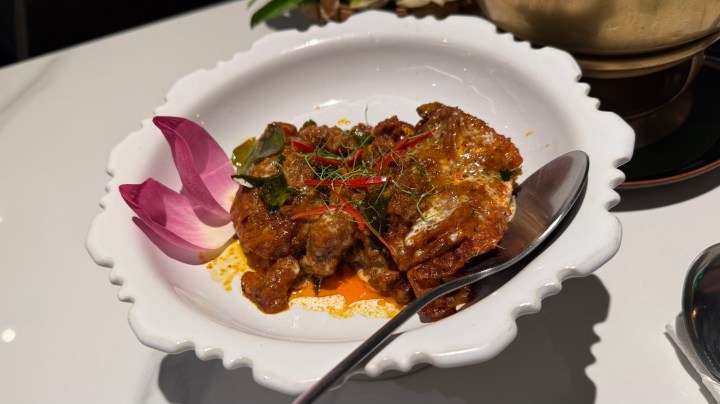
Phanaeng Poo Nim is soft-shell crab with Panang curry. The crab, having just molted its shell, was entirely edible and fried to achieve a slight crispiness. The Panang curry was thick and rich, made with coconut milk and Panang curry paste, which includes ground peanuts and delivers a deep, full flavor.
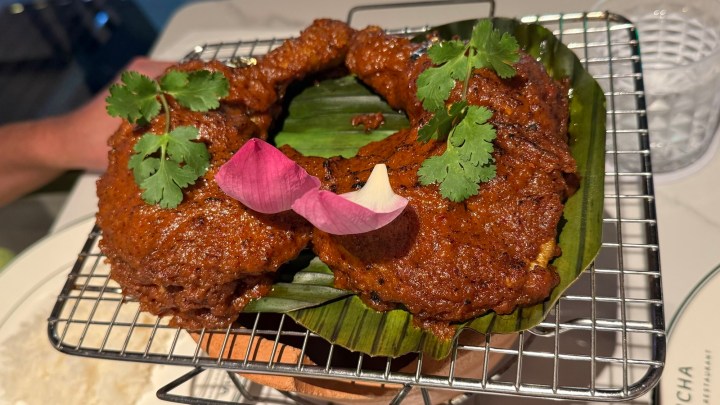
Kai Kolae, called Grandmother’s Red Sauce Chicken Legs at the restaurant, is a Southern Thai grilled chicken dish with strong Malay culinary influence. The chicken is grilled over charcoal while being repeatedly basted with a thick, aromatic curry sauce. The name “Kolae” comes from the local Malay dialect, meaning “to turn or rotate,” referring to the constant flipping of the chicken during grilling. The curry-based marinade includes coconut milk and is sweet and sour from palm sugar and tamarind juice. The chicken was juicy and tender, and the sauce rich and creamy with a deep, layered flavor. Pickles were served on the side.
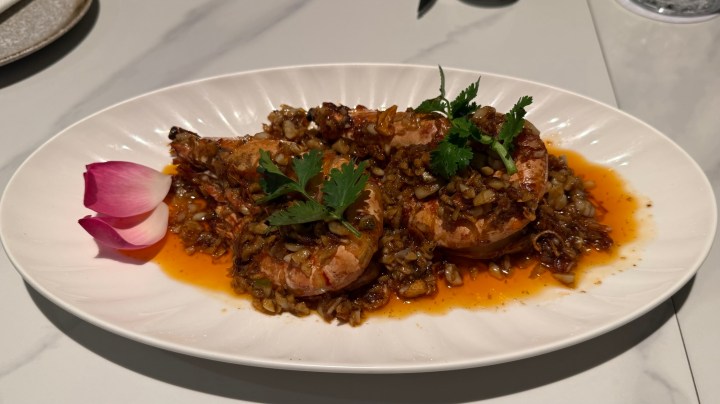
Grandma’s Style Garlic Stir-Fried Shrimp featured large tiger prawns cooked with plenty of garlic and a touch of chili. The prawns were perfectly cooked and juicy, but while the garlic complemented them well, it slightly overpowered their natural flavor.
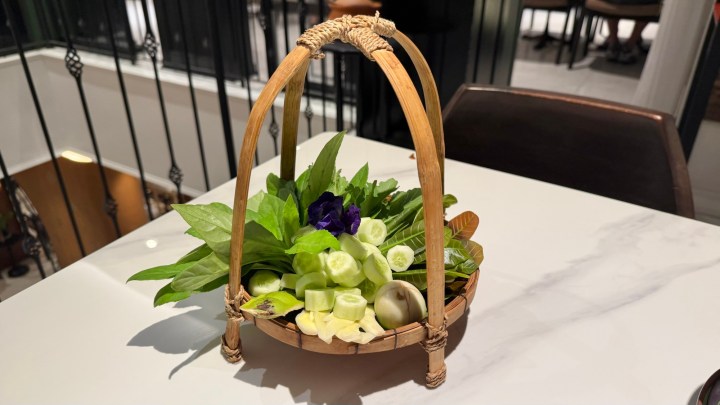
On the first day, an assortment of fresh leaves along with cucumber, thinly shaved ginger, and raw eggplant was served with the mains. The waitress explained these accompaniments are not just garnish; they play an important role in balancing flavors and refreshing the palate. They cool the mouth after spicy bites, add crunch to contrast soft curries or grilled meats, and bring brightness and complexity to rich dishes.
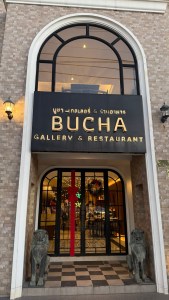
It was very nice to try all these local dishes at Bucha. As this was my first time in southern Thailand, I had to take their word for the authenticity of the dishes, but they certainly came across that way. The service was very attentive, which may have been because there seemed to be about as many staff as guests. Perhaps this was due to the street food festival at the temple across the street, or because the restaurant is not in one of the touristy areas. It’s definitely worth taking a Grab or Bolt to get here if you’re in Phuket.
When I’m back home I’m certainly going to try and prepare some of these dishes at home, so you can expect to see some recipes in the near future.


Again you managed to find such an interesting place – this time in touristy Phuket where I have never been. Am scrolling up and down two days’ menus unable to guess how close to the ‘real’ the food came . . . The soft-shell crab and the first courses from both days certainly attract . . . and I do like the first day’s tray of leafy accompaniments. Like your comfortable chairs . . . perchance not the Luna Park view . . . but that is me 🙂 ! I always found the ‘heat’ of Thai dishes hard to ‘guess’ . . . but, as I may have previously said, the first time I ended up in a Bangkok restaurant before you were born, being totally immature and smart-alecky > when the charming waiter suggested ‘mild’ I took ‘offence’ and more or less informed him I surely could manage at least ‘medium-hot’ . . . oh, oh, oh, I very much paid the price with the whole restaurant staff laughing in the corners . . . but I ate it ALL, being rather ill in the hotel afterwards 🙂 !!!
LikeLiked by 1 person
I think the Thai are more used to tourists now. What I do at home is when a recipe calls for a certain number of dried chillies, I use half of that number in mild large chillies and the other half in strong small chillies. By weight the hot chillies are a lot less than 50%. It still becomes quite spicy but a tolerable level for me and most of the people I cook for. Dutch people are often used to spicy food from traveling or because of the Dutch-Indonesian food. Here medium spicy is at most half as spicy again of what I do at home. When I order, they seem to assume westerners don’t like spicy at all.
LikeLiked by 1 person
Stefan – I remember some of the best Indonesian food of my lifetime from a couple of Amsterdam restaurants way back when. . . . and, when I first landed in Bangkok, tourists were still very weird creatures few-and-far-between . . . thank God we had Western friends living there and loving it, and showing us and teaching us, so . . . have a happy trip home . . . and may the winter be to your liking . . .
LikeLiked by 1 person
We visited Phuket on our first trip to Thailand 25 years ago, and even back then it was very touristy. I enjoyed a stay in Kamala, which retained the vibe of a Muslim fishing village.
We were proud to figure out how to get a bus from the airport, and hopped off in Kamala in the hot midday sun without a room reservation. All 3 hotels were full. The town council limited hotel construction. We were on the street with our luggage, scratching our heads when a hotel employee offered us her teenage daughter’s room. It had a single bed, nor airco and some WHAM! posters which we deemed too uncomfortable for the two of us especially given the heat. Back on the street another woman beckoned and led us too a beachfront house where the family had built on a room to rent out to tourists. It had a view of fishermen on the beach in the mornings. What a wonderful stay.
If we ever use Phuket Airport again, we will look into the smaller islands reachable by ferry nearby. They are likely to be less touristy.
A neighbour once asked a cook to make Som Tam “the way she made it for her family”. It blew her head off.
LikeLiked by 1 person
Magnifica questa recensione! Non vedo l’ora di leggere le ricette degli stessi piatti preparati da te
LikeLiked by 1 person