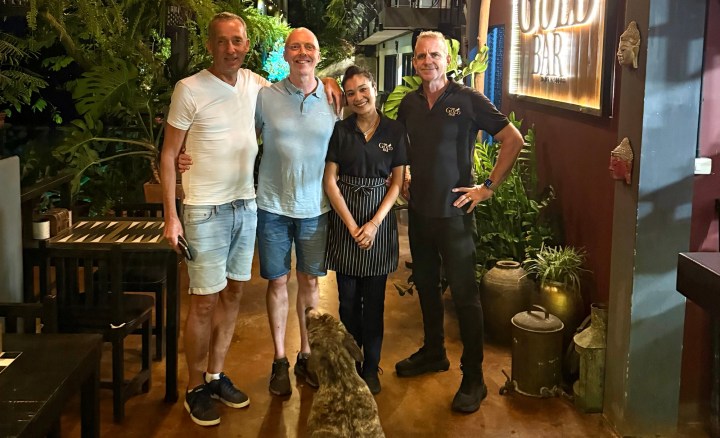
Chris, originally from the UK, moved to Thailand 29 years ago to be with his Thai wife. Together they built The Gallery Restaurant and Gold Bar on the island of Koh Tao, perched on a hill, which is also their home.
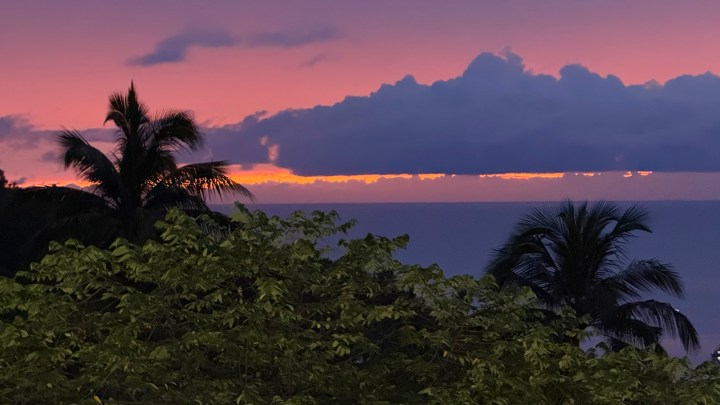
From here you can enjoy stunning sunset views—even on a cloudy day like today.
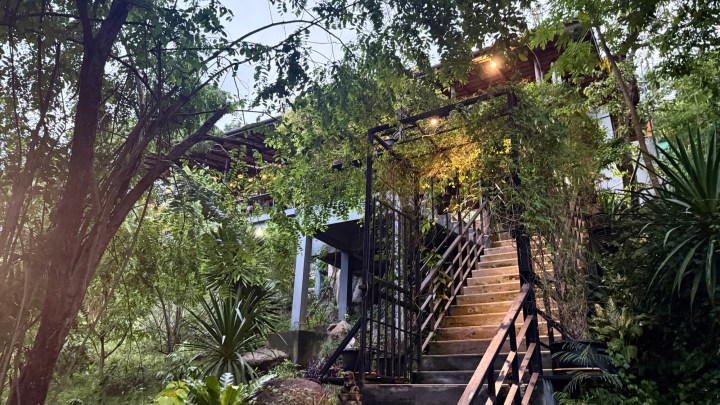
The restaurant opens only on Mondays, Wednesdays, and Fridays, offering a set menu called Trust the Chef. Guests are asked to arrive at 6 p.m. to watch the sunset; dinner starts at 7 p.m. and runs until about 10 p.m. The website explains clearly what to expect (and what not), and Chris requires you to read and agree to this before confirming your reservation.
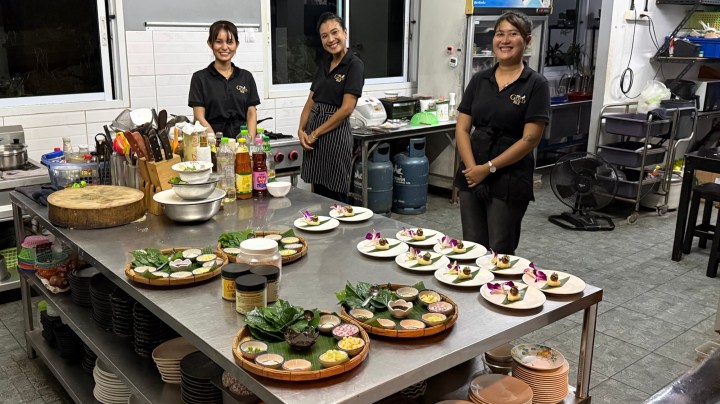
The set menu consists of about 10 courses and costs THB 3,200 per person (around €88). This was right up our alley, as we always “trust the chef”—at least when dining at a certain level—and prefer chef’s or tasting menus over à la carte.
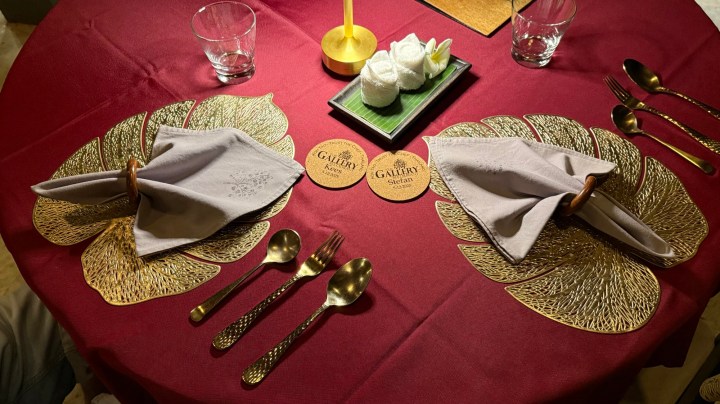
Chris had asked for the first names of all guests, and when we arrived at our table it became clear why:
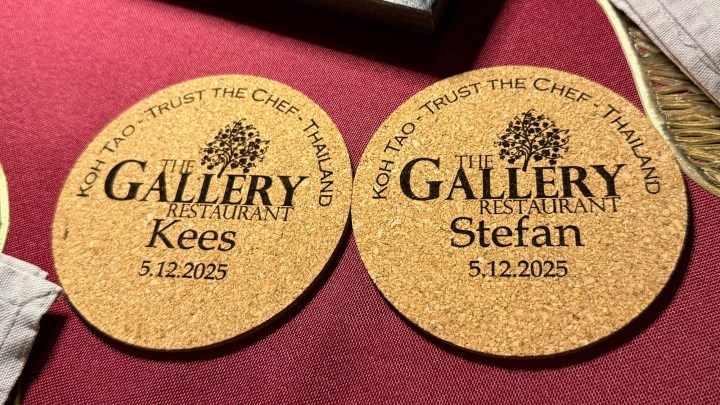
He had created personalized coasters with our names.
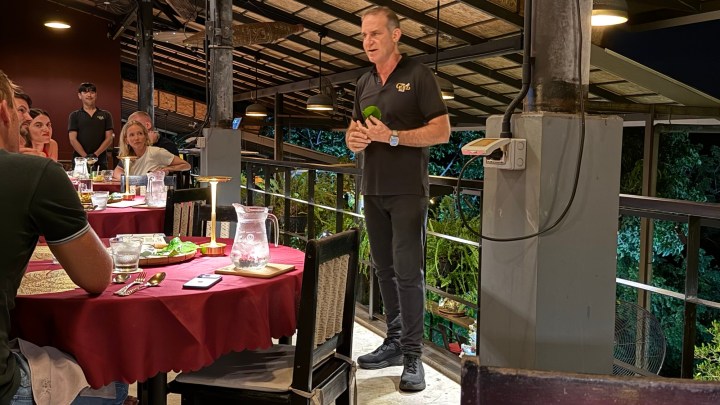
Chris introduced every dish in detail, explaining its origin, the ingredients used, and the health benefits of the herbs. He confirmed something I had already noticed: in Thailand, the herb often features prominently in the name of a dish rather than the protein. What I would call “stir-fried chicken with basil” is simply “stir-fried basil.” Just like at Bucha, where the “banana blossom salad” also included large steamed prawns that weren’t even mentioned on the menu.
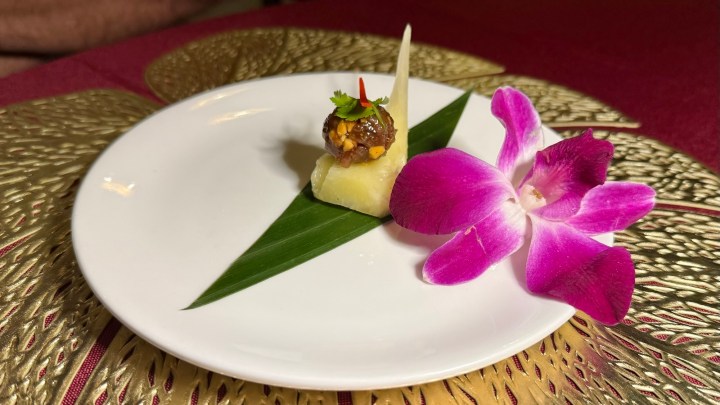
The amuse-bouche was Maa Hor (ม้าฮ้อ), which Chris described as a “palate opener” to awaken the taste buds. Originating from northern Thailand, it consists of a slice of fresh, sweet pineapple topped with a rich pork and peanut meatball. The name means “rocking horse,” as the pineapple slice is shaped like a rocking chair. As always in Thai cuisine, this bite balances sweet, salty, sour, and spicy flavors.
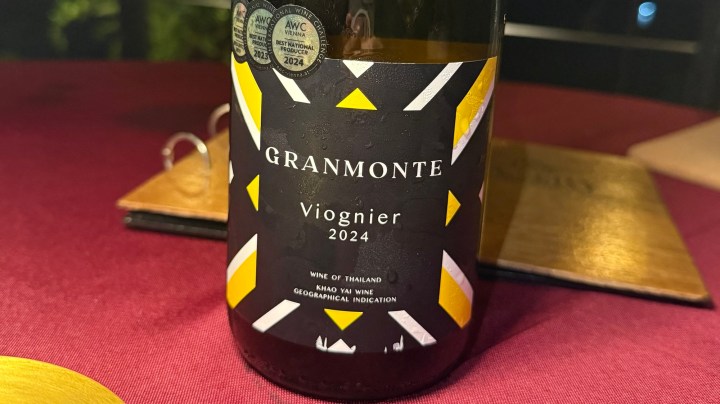
The restaurant offers wines exclusively from one Thai winery: Granmonte, reputedly the best in the country. We had a Viognier, and it was surprisingly good, considering Thailand lies well outside the climatic zone suitable for wine production. The wine was well balanced, with classic Viognier aromas complemented by vanilla notes from oak.
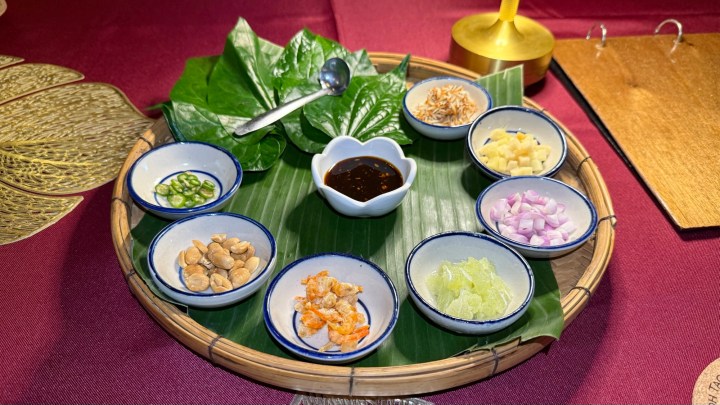
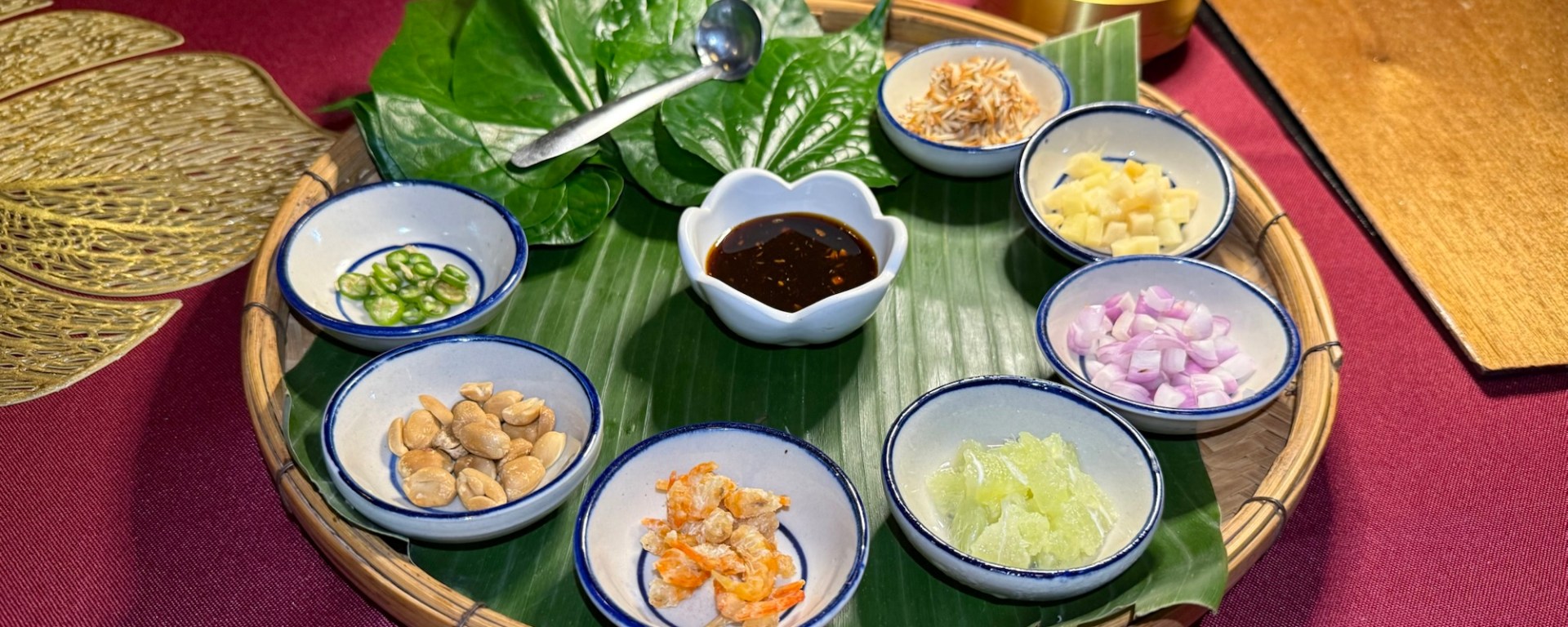
The first dish was a famous appetizer from the North called Miang Kham (เมี่ยงคำ). This one-bite snack is assembled by folding a wild betel leaf into a cone and filling it with toasted coconut, ginger, shallot, lime, dried shrimp, roasted peanut, chili, and a sauce of caramelized palm sugar with fish sauce. What set this apart from the Miang Kham I’ve had before in the Netherlands was the exceptional quality of the ingredients—especially the toasted coconut, dried shrimp, betel leaves, and the palm sugar. Chris explained that this palmyra palm sugar is hard to come by, even in Thailand. Compared to regular coconut palm sugar, palmyra sugar has a deeper, more complex sweetness with subtle caramel and smoky notes.
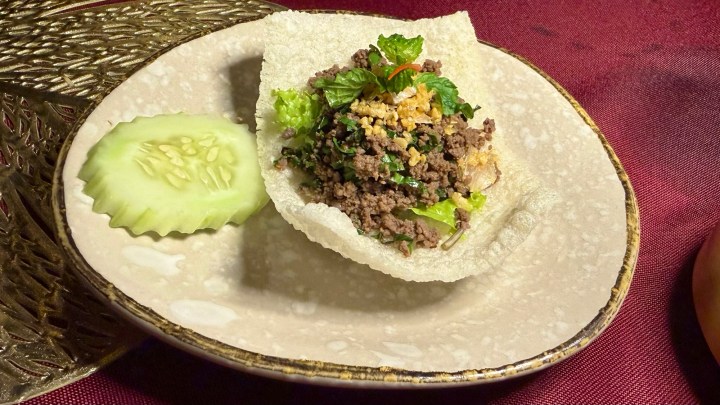
We continued with Laap Kua (ลาบคั่ว), served on a rice cracker. The rice cracker wasn’t as crispy as the one at Bucha, perhaps because of the very high humidity here. Chris explained that rice crackers were originally invented to use up rice that had stuck to the clay pot in which it had been cooked and kept warm (though not made that way at the restaurant).
Laap Kua is from Northern Thailand and differs from regular Laap from Isaan in the northeast. This version was made with beef and contained 19 herbs and spices. Laap from Isaan is fresh and fiery, whereas Laap Kua is earthier, more aromatic, and less sour. I’ve had it before in Northern Thailand, and this rendition was more complex and elegant.
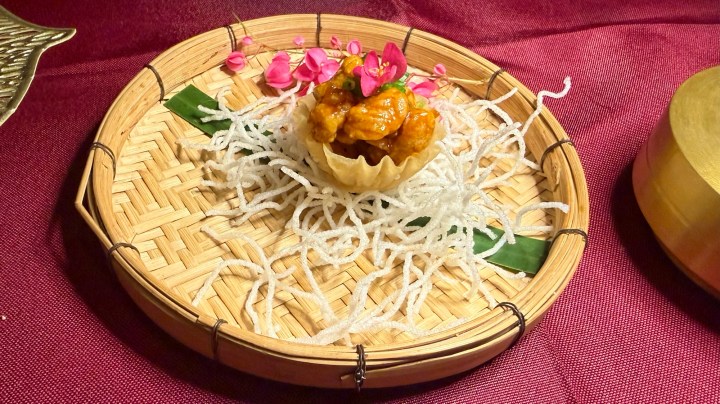
The next dish was Gratung Tong (กระทงทอง), a chicken and cashew family recipe of the chef. The name translates to “gold cup”, which refers to the delicate pastry shell and not to the chicken and cashew filling.
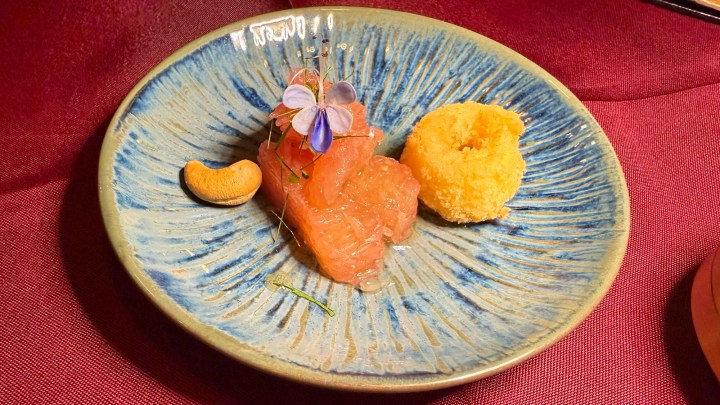
The following dish was Som O Pick Ga Glua (ส้มโอพริกกะเกลือ), pomelo with salt and pepper sauce. This was a Siamese ruby pomelo, which has a sweeter flavor than a regular pomelo. It paired beautifully with the salt and pepper sauce and was accompanied by a toasted cashew nut and a crispy deep-fried squid ring.

From the restaurant we could see fishing boats in the bay using bright lights to attract squid—a technique that stops working as soon as the full moon rises. The squid for this dish was sourced from one of those local fishermen and was therefore exceptionally fresh.
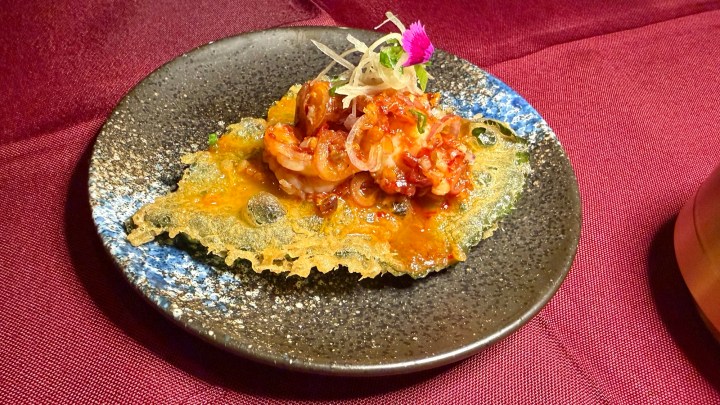
We continued with Yum Bai Mon Grob (ยำใบหม่อน), a battered and fried mulberry leaf topped with a salad of banana shrimp. The name literally means “crispy mulberry leaf salad,” so once again the dish is named after the herb. Chris explained that this type of fried leaf was traditionally used as an edible plate to serve food. It was perfectly crispy, while the salad was rather sweet.
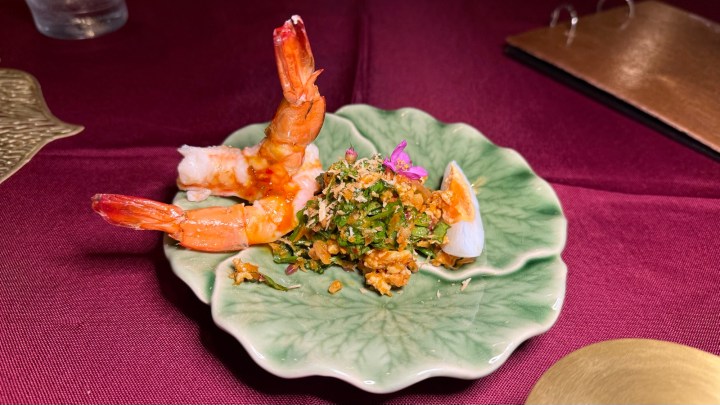
The final dish before a short break was Yum Bai Bua Bok (ยำใบบัวบก), a salad with Centella leaves, also known as Indian Pennywort. The leaves have a slightly bitter, herbal taste, balanced in the dish by the sweetness of palm sugar and the nuttiness of roasted peanuts. It was served with a bit of duck egg and two white Malaysian prawns.
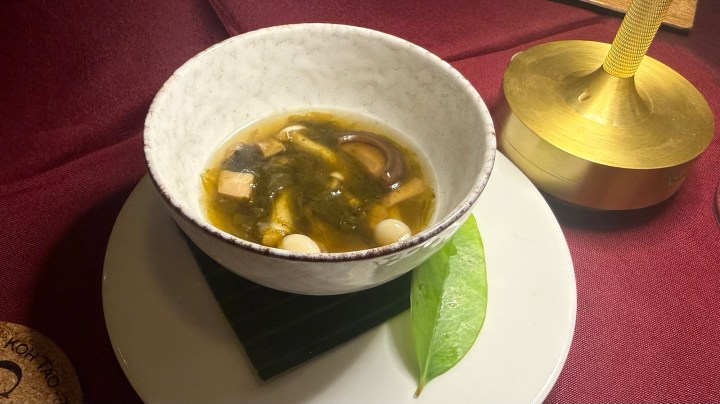
After a short break in the Gold Bar, we resumed our meal with Tom Bai Chamuang Het Saam Yang (ต้มใบชะมวงเห็ดสามอย่าง). This traditional soup from southern Thailand has a distinctive sour, earthy, and salty flavor. The sour, aromatic, and slightly fruity notes come from the leaves of the Chamuang tree. The chef even provided a fresh leaf next to the soup so we could taste it on its own. The earthy flavor comes from three kinds of mushrooms.
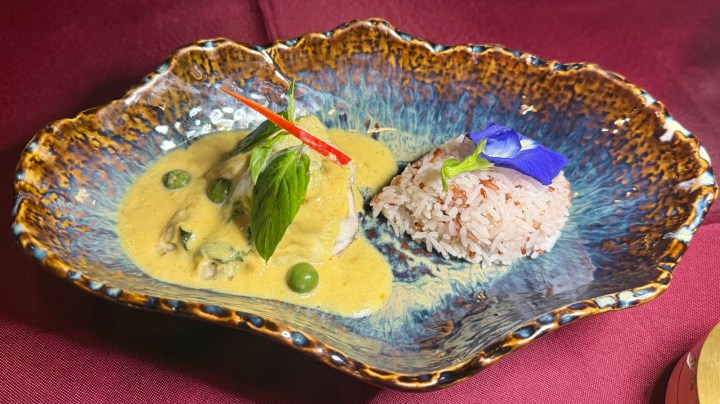
The main course was Gang Kua Luuk Glouy (แกงคั่วลูกกล้วย), a herbal curry with immature bananas (starchy rather than sweet), white snapper, miniature eggplants, and a butterfly pea flower. The curry was very elegant and well balanced. I was especially impressed by the miniature eggplants, which had a much nicer flavor than usual—less bitter, more fruity, and with a pleasant ‘pop’ texture. The chef explained this was because they were freshly picked from her garden and blanched for three minutes.
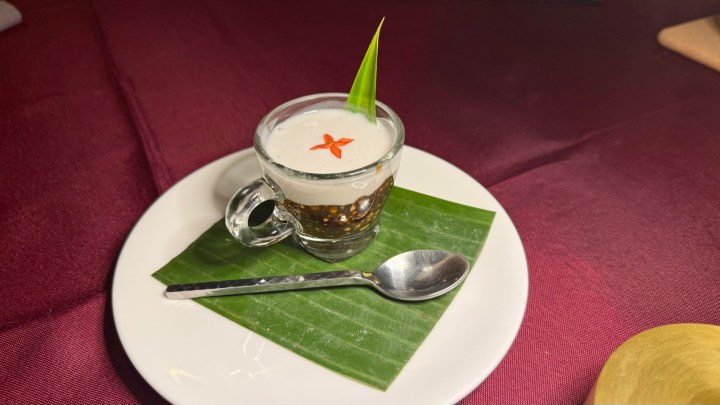
The dessert was Saku Dton (เปียกสาคูต้น). This is made from starch that is freshly extracted from the pith of tropical palms (a lot of work for the chef) rather than factory-made tapioca pearls. It also included the classic Thai dessert components of coconut milk and a pinch of salt.
We’ve had a wonderful evening at Gallery Restaurant. All the food was delicious. The website states: “The spice levels of each course are created by the Chef according to traditional tastes using all the original herbs and spices, some dishes are spicier than others, we will not adjust the spice levels.” This made me think there would be very spicy dishes with a lot of chili, but there was hardly any chili heat. The dishes were all well balanced in the Thai tradition.
If I had to offer a critique, it would be that the balance was sometimes on the sweet side for my palate and that the dishes were served lukewarm (preheated plates would help). The explanations by Chris were both entertaining and educational. It is very clear he loves both the chef and Thai food very much. The service was flawless, and the pace of the evening was just right.
As this experience has some striking similarities to our dinner at Locus Native Food Lab in Chiang Rai, it makes sense to compare the two. At Gallery Restaurant all the dishes are traditional, rather than partly innovative like at Locus. Both restaurants showcase Thai ingredients and culinary traditions, but Locus focuses on the North, whereas Chris and the chef travel all over Thailand to discover recipes from across the country. Both restaurants offer extensive commentary on all the dishes in unaccented English, but at Locus it is done by the chef (with the sous chefs doing the cooking), whereas here the explanations were given by the chef’s husband (with the chef hard at work in the kitchen).
What sets The Gallery Restaurant apart from most other Thai restaurants we’ve visited is the quality of the ingredients, the precision of the preparations, and the authenticity of the recipes. And of course the explanations and the beautiful setting of the restaurant.


Stefan and Kees – you two fully deserve it, but, oh boy you are the proverbial lucky ducks! I am ‘talking from the page’ but methinks I would have enjoyed this even more than the ‘Locus’! And . . . I think I could have sat there the whole night with a glass of wine looking at the fishing boats . . . thank you so much for taking us there . . . I just looked at the date on the coaster . . . what a lovely share of the here-and-now . . .
LikeLiked by 1 person
I write restaurant reviews always the next day, as I do most from memory with some help from a written menu and very rarely notes. Recipes can sometimes be blogged months after cooking and photographing them, as I take extra photos as ‘notes’ (e.g. of scales showing the right amount of an ingredient) and can write the blog post just from the photos.
LikeLiked by 1 person
Stefan – I respond from the viewpoint of the reader far away dreaming of being there also . . . to know you ‘did this’ just last night when I actually was watching a foodie TV show made somewhere months before . . . well, it does make one feel ‘part of it’ 🙂 !
LikeLiked by 1 person
How are you finding your restaurants? We’ve been to the Koh Phangan, Koh Tao area a couple of times because we like snorkelling and weren’t aware of special restaurants there.
LikeLiked by 1 person
I google, ask AI, ask for recommendations locally, and then read reviews and menus to verify. We don’t have so much experience in Thailand, but do notice that restaurants that serve authentic Thai food are rare. More so in touristy areas.
LikeLike
PS perhaps obvious, but I do invest time in this. This is not Italy where you can just walk around a bit and easily find a restaurant with authentic food.
LikeLike
We often ask ordinary people where they eat themselves, such as skippers on boats, taxi drivers, hotel staff. We’ve been to places we would have overlooked because they were nothing to look at but served good food. The only time we were recommended something high end was when someone told us about a restaurant where his grandad celebrated a big birthday.
I remember a tip I once read in a guidebook: Do not be alarmed if a Thai person asks what you plan to eat for dinner. They are not inviting themselves to dinner. This is the standard way to start a conversation with a stranger, like complaining about the weather in the UK. I haven’t met a Thai person who didn’t like talking about places he likes to eat.
LikeLiked by 1 person
Looks so tasty!
LikeLiked by 1 person
Tutto bello, e che straordinaria eleganza!
LikeLiked by 1 person
What a beautiful experience, and the food looks wonderful. I find Thai Food rather hot here in Toronto so it was nice to read that your experience wasn’t as hot! Thai food here, also tends to be on the sweeter side, which is why I like to make my own at home.
LikeLiked by 1 person
I am a huge fan of Trust the Chef styles of menus, but like you, I do not like lukewarm food and prefer my plates heated for hot courses. What stunning views. The squid boats are visible from our balcony so I can relate to what you were seeing 🙂
LikeLiked by 1 person
Wow – what a fantastic evening. From the personalized coaters to the decadent menu – wow! What a find! And all this for $88! Wow!
LikeLiked by 1 person
Thailand is a beautiful country. I had the pleasure of visiting this past March. a life changing experience. This menu looks absolutely amazing. Thanks for sharing with us.
LikeLiked by 1 person
still on my bucket list. thank you for sharing
LikeLiked by 2 people
I love Thailand!
LikeLiked by 1 person