As a member of the Dutch association of wine connoisseurs with a level 4 diploma (Verenigde Vinologen Nederland), I serve on the VVN travel committee. Together with Fred Nijhuis, I organize wine trips to Italy. Following our previous journeys to Campania in 2024 and Friuli in 2025, we are visiting Emilia-Romagna and the Marche this year. Both are lesser-known Italian wine regions, which is precisely what makes them so interesting to explore.
I have long wanted to bring a group to the Marche, as I believe Verdicchio is significantly underrated. Since Bologna is the closest airport to the Marche wine areas with a direct flight from Amsterdam, and because Emilia-Romagna also offers underrated wines, it made perfect sense to combine both regions into a single tour.
We began our journey in Emilia with Lambrusco. This is perhaps the most misunderstood wine of all, hampered by a reputation for the cheap, mass-produced bottles typically found on the bottom shelves of supermarkets.
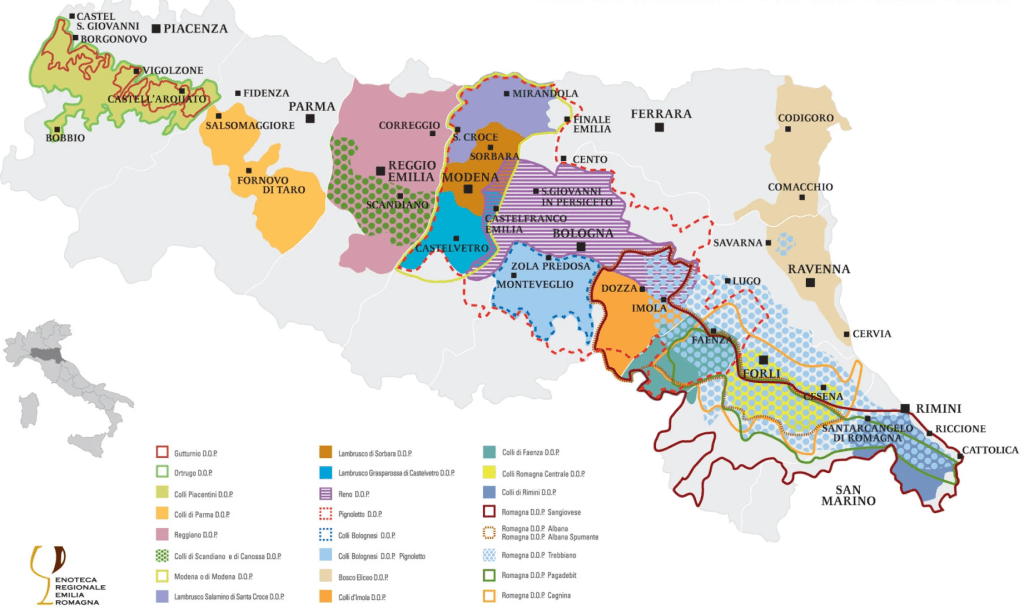
All Lambrusco is sparkling. While most are produced using the Martinotti/Charmat method with second fermentation in a tank, the highest quality wines are made using the classic method of second fermentation in the bottle, just like Champagne. There are seven DOCs for Lambrusco; six are located in Emilia, while Lambrusco Mantovano DOC is in Lombardia. Three of these DOCs focus on a single grape variety from a specific geographic area.:
- Lambrusco di Sorbara DOC, made from Lambrusco di Sorbara, sometimes with some Salomino. Elegant and with a light color.
- Lambrusco Grasparossa di Castelvetro DOC. Deep purple with tannins and a full body.
- Lambrusco Salamino di Santa Croce DOC. In terms of color, body, and tannin in between Sorbara and Grasparossa.
Then there are three DOCs from geographical areas that use a blend of different Lambrusco grapes: Modena DOC, Reggiano DOC, and Colli di Scandiano e di Canossa DOC. In addition to the varieties already mentioned, these blends may include Maestri, Marani, and Montericco.
Lambrusco comes in the following levels of sweetness:
- Secco (Dry), up to 12 grams of residual sugar per litre (or up to 15 grams if the wine has at least 5 grams of total acidity per litre)
- Semisecco / Abboccato (Medium-Dry), between 12 and 32 grams of residual sugar
- Amabile, 30 to 50 grams of residual sugar
- Dolce (Sweet): more than 50 grams of residual sugar
Most of the highest quality wines are Secco, though some are produced as Abboccato.
Paltrinieri
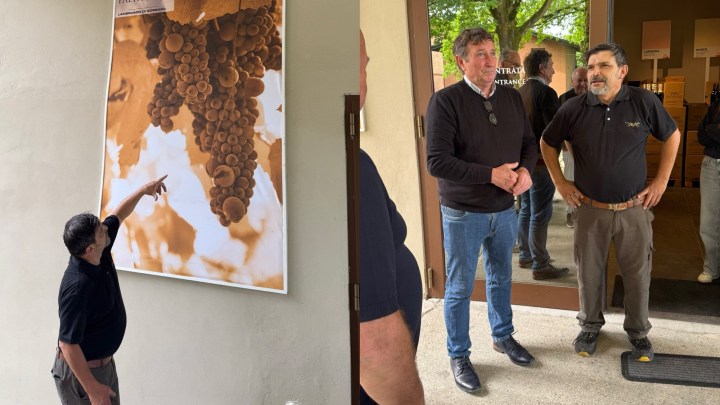
Our first visit was to Cantina Paltrinieri, where we were welcomed by Alberto Paltrinieri himself. The winery is in the town of Sorbara in the area of Lambrusco di Sorbara DOC on the flat, alluvial area between the rivers Secchia (west) and Panaro (east), north of Modena. Alberto explained that the different Lambrusco grapes are a group because they have been cultivated for a long time in this area, but are not a family as they are not genetically linked. He also pointed out the different in berry size in clusters of Lambrusco di Sorbara grapes. This is because the stamens, the male part of the flowers, are bent backward. Grape vines are normally self-pollinating, because the the pollen from the stamen fall easily on the stigma (female part). This is not the case in Sorbara, so they don’t self-pollinate effectively, leading to coulure (poor fruit set). A partial fix for this is to plant Lambrusco Salamino grapes in the same vineyard. They flower at the same time and produce abundant pollen, which are carried to the Sorbara by wind and insects. It is now even a requirement in the disciplinare for Lambrusco di Sorbara DOC to plant Salamino in the samen vineyard. Top producers like Paltrinieri prefer to produce a 100% Sorbara. Not because Salamino isn’t a good grape (it is), but to get the pure elegant Sorbara character in the wine. To facilitate this, they plant the Salamino in separate rows so that they can be picked separately. This is also better for optimal ripeness at harvest, as Salamino ripens a few days to a week earlier than Lambrusco.
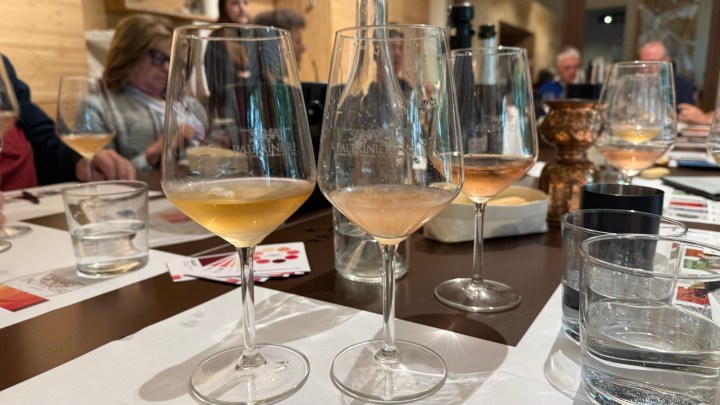
Something else that is very typical for Lambrusco di Sorbara is the “refermented in bottle” method to create a sparkling wine. The most common methods are second fermentation in tank or in bottle, where the yeast is removed after the second fermention and lees aging (degorgement). Here a second fermentation in the bottle is initiated by adding sugar (4 grams per liter for every bar of pressure to be reached) just like for the regular classic method, but the degorgement is not carried out. This means that the yeast is still in the bottle. To demonstrate this, Alberto purposely did not shake the bottle before pouring. On the photo you see the difference between the first and the last glass from that bottle. The yeast makes the wine cloudy and adds flavor and texture. This is not the same as the ancestral or petnat method, because for those it is the first fermentation from the sugar naturally present in the grape must that is completed in the bottle. Rather than a second fermentation that is initiated after the first fermention has finished, by adding sugar.
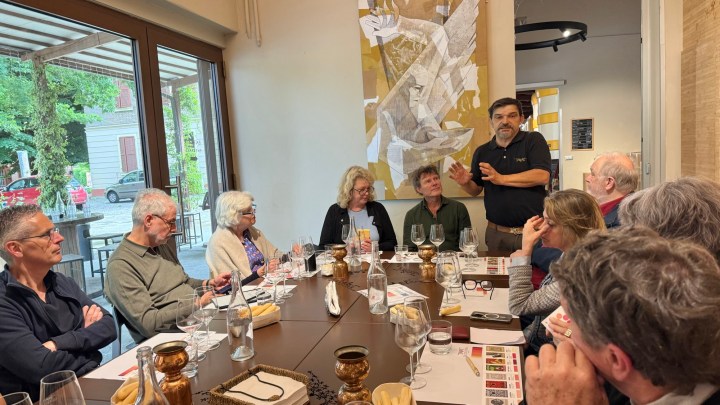
Lambrusco was traditionally made in frizzante style with a low pressure of 2.5 bars, created by adding 10 grams of sugar for the second fermentation. Now it is also produced as spumante with 6 bars, for which 24 grams of sugar are added. Note that all of that sugar is fermented into alcohol and CO2 (the bubbles), so no residual sugar is left unless it is added after removing the yeast (degorgement). This is why a “refermented in bottle” Lambrusco is always completely dry, whereas Lambrusco made with Martinotti or metodo classico can have sugar added after the degorgement to make it sweeter. Alberto also explains that the second fermentation is carried out at a cool temperature of 16-18 degrees Celcius to achieve a more delicate and more persistent mousse.
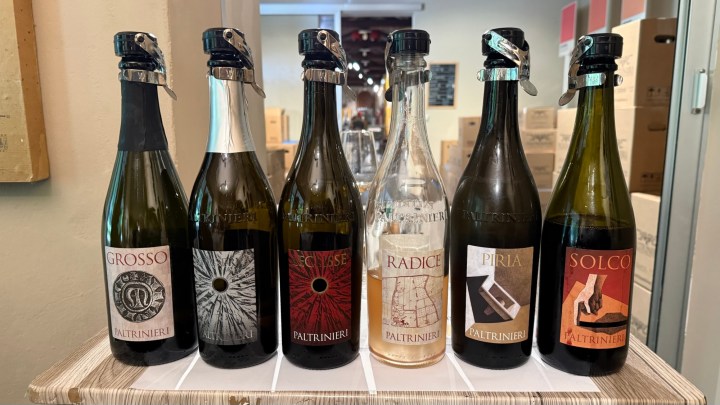
We tasted these wines at Paltrinieri:
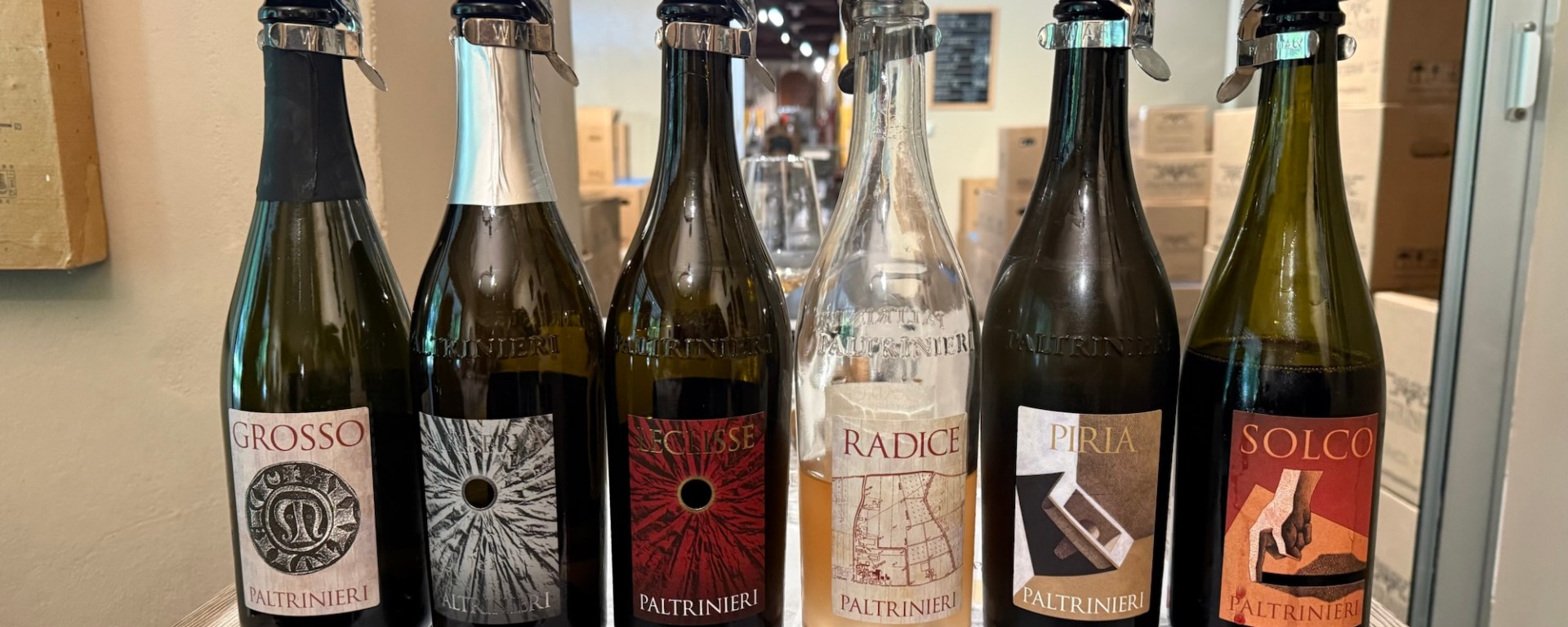
- Grosso 2022 Spumante Metodo Classico, 100% Sorbara. Made with partial malo and classic method with 24 months of lees aging, zero dosage. Very pale color, aroma of rhubarb, high acidity but balanced, note of almonds on the palate.
- Lariserva 2023 Spumante Riserva, 100% Sorbara. Made with Martinotti method, but with 12 months of lees aging, zero dosage. This is an expensive application of this method, because the usual time on the lees is 4 months so you can use the same expensive tank space three times in one year. So unlike most sparkling wines made with the tank method, this wine does have a clear aroma of toast from the lees aging. Paltrinieri called this wine “Lariserva” to provoke, because this wine demonstrates that Lambrusco can be aged, while it has a reputation to be drunk only young.
- Leclisse 2024 Lambrusco di Sorbara DOC, 100% Sorbara, frizzante, Martinotti method with 4-5 months of lees aging. Elegant and fresh with aromas of raspberries.
- Radice 2023 Lambrusco di Sorbara DOC, 100% Sorbara, frizzante, refermented in bottle. Earthy with a soft mousse.
- Piria 2025 Lambrusco di Sorbara DOC, 70% Sorbara with 30% Salamino. Pink color. Fresh, fruity, and soft.
- Solco 2025 Lambrusco dell’Emilia IGT Semisecco, 100% Salamino. Doesn’t taste sweet despite the “semisecco”. Beautiful blackberry fruit, soft bubbles.
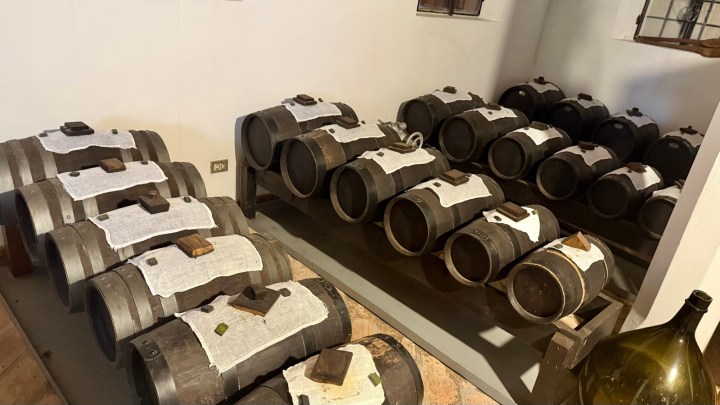
We also visited the acetaio, where the traditional balsamic vinegar is aged. The difference between regular and “traditional” balsamic vinegar is significant. Traditional balsamic vinegar is made from grape must only, which is reduced by boiling and then aged in a series of progressively smaller barrels made from different types of wood for at least 12 years, and 25 years or more for the highest category. The ageing system resembles a solera but is not a true solera system. It becomes very dark and complex and can only be sold as aceto balsamico tradizionale after approval by a tasting panel. Regular balsamic vinegar (Aceto Balsamico di Modena IGP) is made from a blend of wine vinegar and grape must, usually aged for a much shorter period, and may include caramel colouring. Quality varies widely, from simple industrial products to well-made, more complex examples.
Cantina della Volta
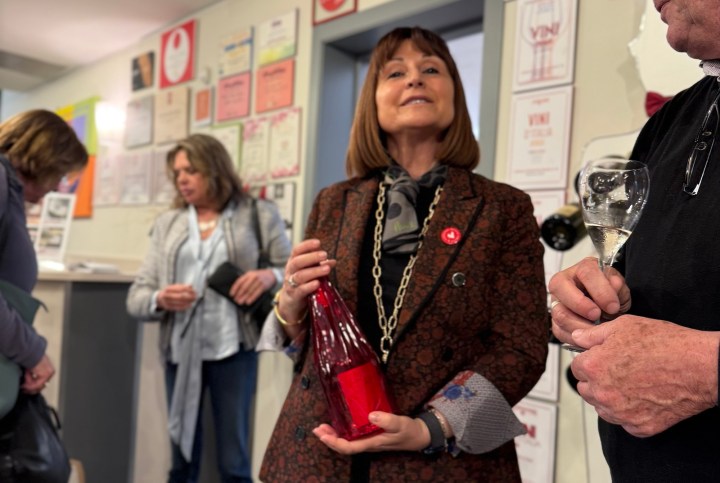
The other producer of Lambrusco we visited was Cantina della Volta, run by Christian Bellei and Angela Sini. We were received by Angela, who showed us the special wrapping used to protect their white Lambrusco di Sorbara from light. While wine is typically packaged in green or brown glass for protection, this white Lambrusco uses a clear bottle to show off its color, necessitating the protective wrap.
Christian was a pioneer in the region, producing the first metodo classico Lambrusco in 1979 after studying the method in Épernay, the heart of Champagne. Lambrusco di Sorbara is particularly well-suited for the classic method because it provides the high acidity essential for quality sparkling wine.
Cantina della Volta works exclusively with Sorbara for its own production. Although they still plant Salamino to assist with pollination, those grapes are sold rather than used in their wines. They focus entirely on the classic method, eschewing the tank method (Martinotti) altogether. To ensure the highest quality, all grapes are hand-picked following a strict selection process in the vineyard.
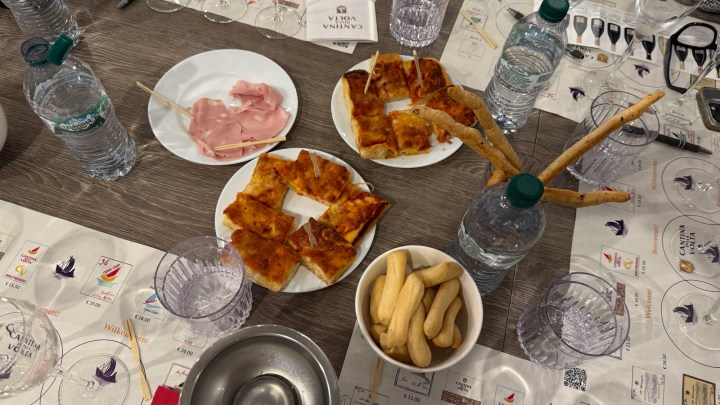
According to Angela, Lambrusco pairs well with pizza. And so we had some pizza with our tasting.
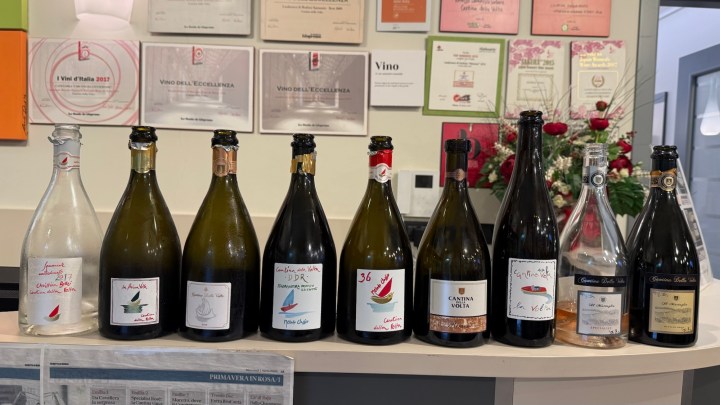
At Cantina della Volta we tasted these wines:
- Il Mattaglio Blanc de Noir 2017 Emilia IGT, 100% Pinot Nero, metodo classico, aged 43 months on the lees and then 3 months in bottle, dosage 3.2 grams/liter. Dry, fresh, elegant, and complex. This wine clearly shows that Christian has studied in Epernay.
- Il Mattaglio Specialist 2018, 100% Pinot Nero, metodo classico rosé, 12 hours skin contact, 48 months on the lees, dosage 2.8 grams/liter. Very nice full fruit flavor.
- La Volta 2025, 100% Sorbara, frizzante, pink-red color, 6 g/l residual sugar.
- Rimosso 2025, 100% Sorbara, cloudy from the refermentation in bottle without disgorgement.
- “36” 2023, 100% Sorbara, metodo classic 36 months aging on lees, pink-red color, rhubarb aroma.
- DDR 2016 (Degorgiatura Dosaggio Recente), metodo classico aged 8 years on the lees. Balanced, full-bodied, deep aroma of cherries.
- Lambrusco di Sorbara Rosé DOC 2020, 100% Sorbara, metodo classic 42 months on the lees, dosage 5 g/l. Pale pink color, fresh.
- La Prima Volta 2020, Dosaggio Zero (no dosage), metodo classico 36 months on the lees, 4 hours skin contact, very dry.
- Christian Bellei Spumante Millesimato 2017, metodo classic 36 months on the lees, dosage 6 g/l, aged, fresh, aroma of strawberry jam.

I can safely say that these two tastings fundamentally changed the opinions—or perhaps the prejudices—of almost everyone in our group regarding Lambrusco. While cheap Lambrusco certainly still exists, there is also exceptionally high-quality Lambrusco available that offers outstanding value for money, precisely because its general reputation prevents producers from asking higher prices. This is particularly true for the metodo classico wines that undergo long aging on the lees, though many of the spumante and frizzante wines were also very impressive.


Great to see you in a country you love doing what you so relish! I know the countryside, have enjoyed the food, had many a bottle of Lambrusco and know virtually nought about it. Weekend lesson ahead – good, even if I pick up just a few basic points. Am amazed as always of your ability to pick up the tiniest nuances for comparison. Lambrusco and pizza . . . would not have thought the latter ever came close to tasting wine . . . one lesson learnt this early morning tide Down Under 🙂 ! Be well and enjoy . . .
LikeLiked by 1 person